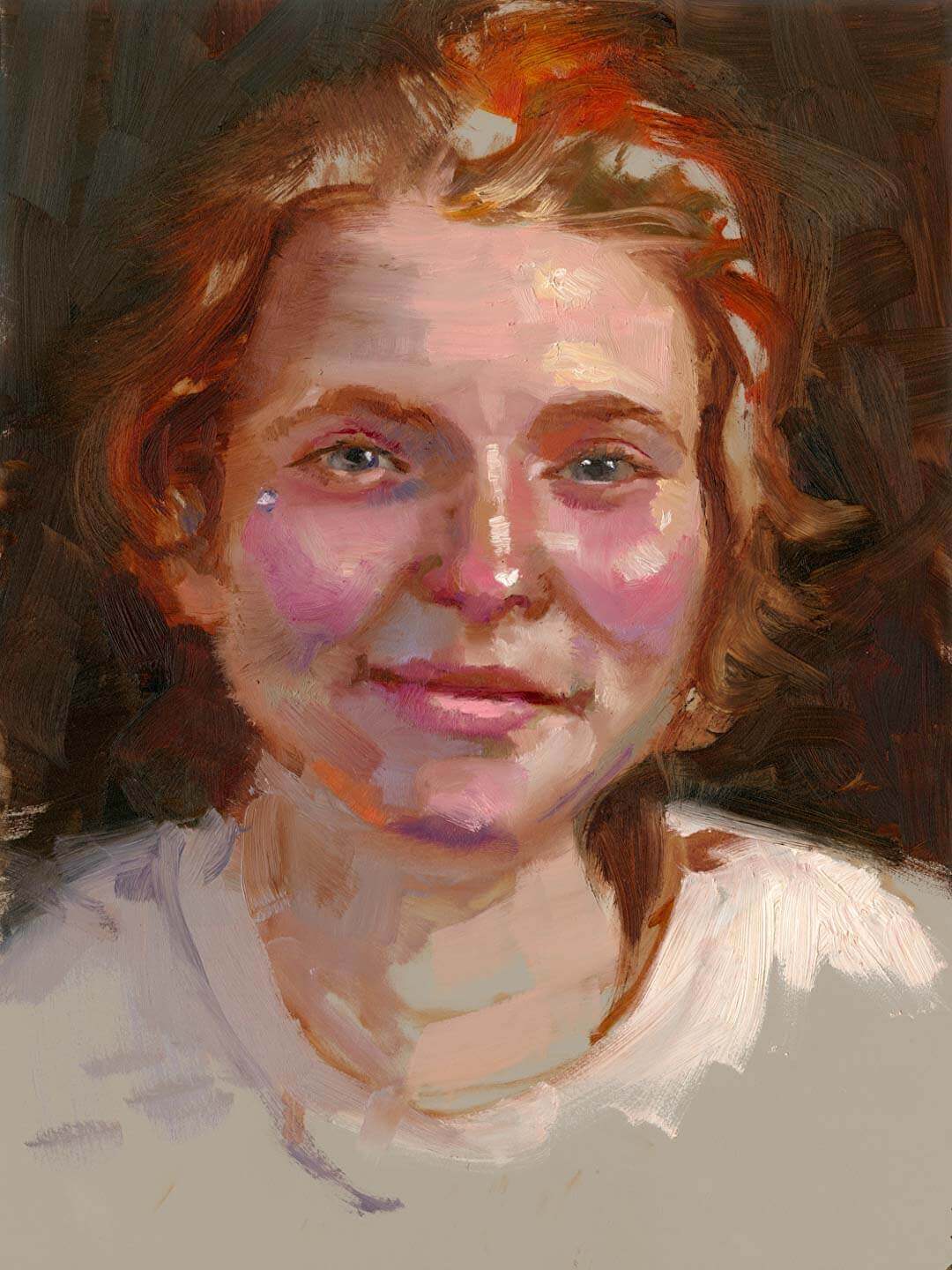

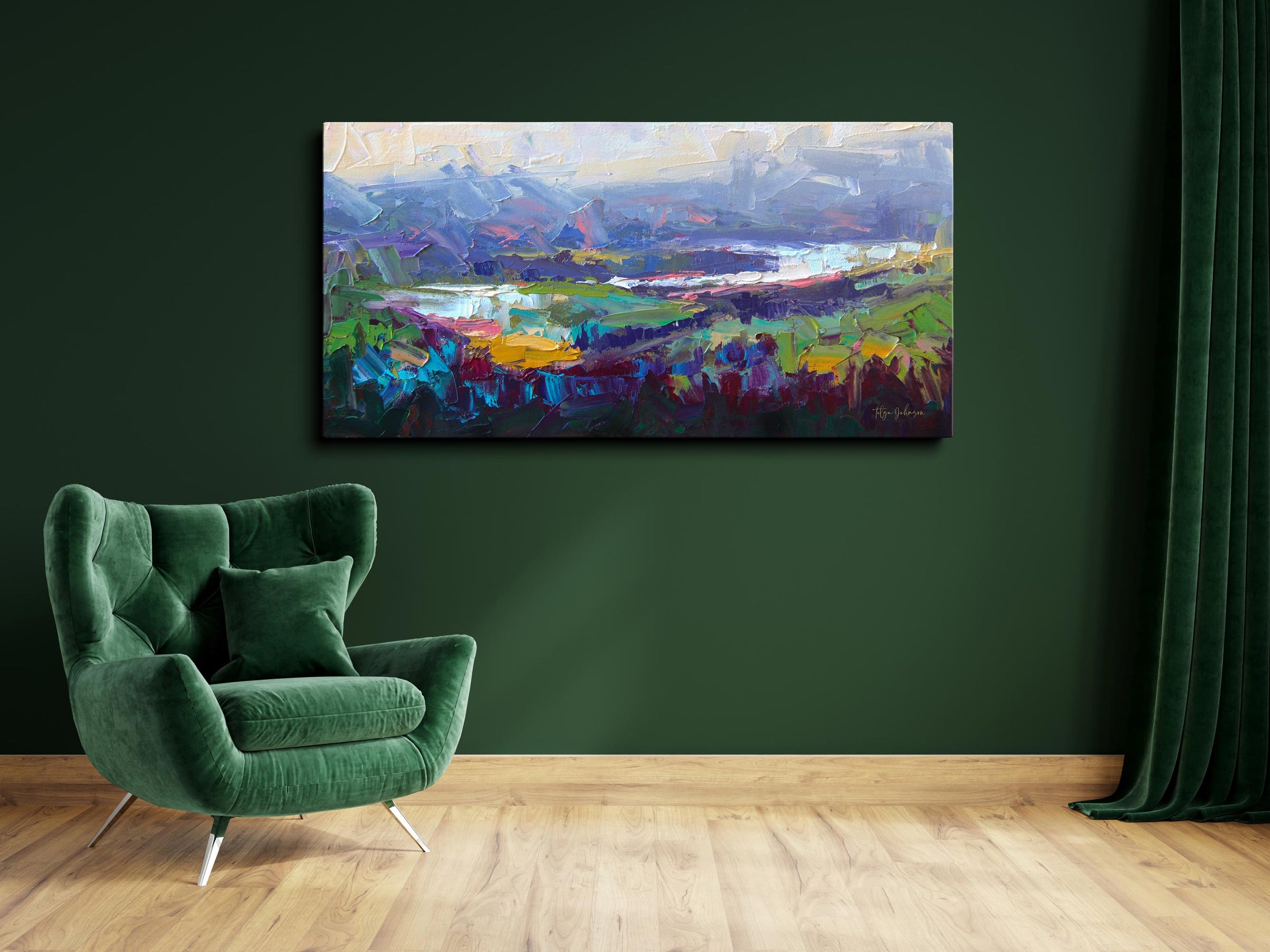
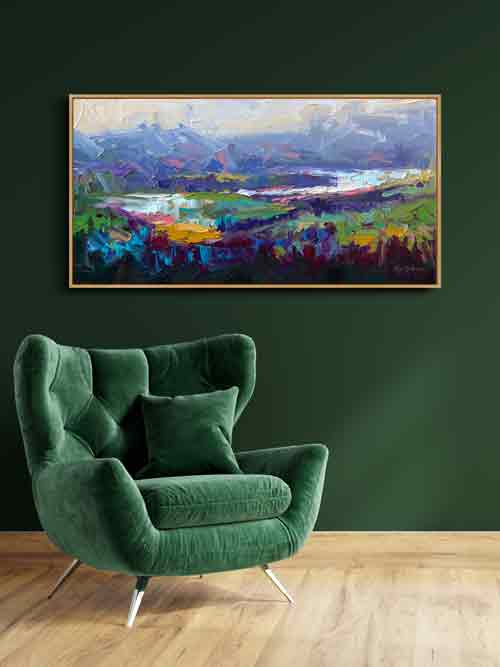
From concept to finished work of art, an oil painter’s secrets revealed!

I suppose that to many, my loose and often colorful style would lead viewers to believe that my paintings are completely spontaneous; with colors randomly chosen from a wide array of paint straight out of the tube. And if that is the ease which I convey, I am quite happy, since it is an illusion that I work very hard at conveying!  In reality, though, most of my paintings are very planned out, with weeks of work before I ever make a mark on my board. While the ideas pour in readily and bombard my thoughts, the execution takes weeks to months of preparation and planning. In the next few posts, I will let all have a peek into my process. Keep in mind, of course, that every painting (like children) usually takes a slightly different approach in the making and raising. ;)

This particular piece, which is yet unnamed will be loosely based on a snapshot that I took several years ago. The first basic step I take is to develop a concept. For me, the concept has mostly to do with the light flow direction of the painting. In order to show my concept, I do many little “thumbnail” sketches or my idea, breaking separating the light from the dark. These thumbnails are quite simple and abstract. At this point I’m not worried about the subject of the painting, only the concept and composition. I make sure that there is unequal balance in my lights and darks. I liken the light to the setting in a literary work, though it isn’t an exact parallel. But the light sets the whole tone or mood of the painting. My thumbnails can be done with any medium; pencil, pen, marker, paint, computer–whatever’s handy and suits my purpose. Once the thumbnails are completed, I lay them all out and choose my three favorites. Then from those, I choose the one I like the best. This can either happen immediately or take a few days for me to decide. I was surprised at my final choice since my reference photo is rather dark, but it seems that here I am more drawn to the lighter division.

Now with concept concretely identified, I need to firm up the composition. The composition is the layout or design of the painting-it’s how the artist has arrangement of the shapes and values (value are how light or dark the area or subject is) of the painting. I sometimes use the armature of the rectangle, to check and tighten up my compositions. The armature is one of the methods used by Renaissance artists.  It “structures” the rectangle using diagonal lines. The two main diagonals divide the area in half, both vertically and horizontally. Likewise the diagonals of those halves will give divisions of fourths and thirds. It all goes back to the universal phi or golden mean or even harmony. There seem to be certain universal proportions that are visible in nature that mathematicians, philosophers, and scientists have identified. Putting them in their simplest terms they are halves, thirds, and quarters. You’ll note later that I use similar proportions to divide my values later on as well. Musical harmony is divided similarly, as are dance steps. Thirds also apply to the pleasing solidarity of the triangle that da Vinci was so fond of. Refer to the notes at the end of this post for additional reference on the armature of the rectangle. So I used Photoshop to re-draw my concept, but this time I used the armature’s divisions and diagonals to align my shapes. You can see, it is still very close to my initial thumbnail. The red lines are the armature of the rectangle.


I didn’t choose to follow ALL the lines, only the ones the suited my concept. I highlighted my chosen divisions in yellow/green. Think of the intersecting lines like a child’s dot-to-dot. The large circle is my focal point. I feel that all successful paintings must have a focal point, a little like the leading actor in a play. I am not terribly faithful to the armature, mostly because I enjoy bringing a little discord or tension into my paintings. Otherwise, my use of bright, happy colors may translate to the viewer as being a little too contrived.

Next I concentrate on breaking up my values. This is often referred to by artists as a value study.  I first separate the lights into two values. Normally I would stop there, but in this case, I wanted to break up the light further, to really bring the eyes toward the focus.

Looking at these from a distance, I’ve also decided to decrease the size of the orb just a smidge. Notice how I lean groupings of threes. There are three trees to the left. Many of the positive (subject) and negative (background) shapes are triangular as well. Then to the right there is the boy, the tree he is leaning on, and the light (looks like the sun?) behind him. The boy represents us, human kind. The light or sun represents our purpose, home, or creation. And the tree is the mediator or facilitator, giving us access to reach the light.  There will be small “sky holes” in the canopy above as well leading our eyes upward as well. A friend of mine has said, “Trees have a majesty and time all their own and represent the tie between heaven and earth. ” How right she is! I did not have this symbolism in mind when I first chose my concept. I was simply attracted to the idea and flow of light. The symbols emerged as I was working out the details. I feel that the value study supports my concept, composition, and focal point beautifully. Working all this out before touching the canvas, and finding the symbols hidden in my mind, really frees me to be more creative and expressive when I start diving into the paint. I am setting up the stage, introducing my characters and conflict so the story can start to unfold. Well, almost…I have to prep my board first and draw out my composition-certainly not my favorite part of the process, but necessary, all the same.


More information on the armature of the rectangle can be found in the following books:

The Science of Art: Optical Themes in Western Art from Brunelleschi to Seurat by Martin Kemp
This one is for the serious scholar-it will take me years to understand it all, but it’s fascinating and well written. The author has other books that look to be a yummy read.

Classical Painting Atelier: A Contemporary Guide to Traditional Studio Practice by Juliette Aristides
This one is easier to understand and more instructively oriented. The composition segment is only a small portion of what the book covers, and is fairly straight forward. IMO a must have for any serious student.

The Painter’s Secret Geometry, By C. Bouleau
 I haven’t read this one but plan on acquiring it one of these days.

Share

7 Responses to “From concept to finished work of art, an oil painter’s secrets revealed!”

  1. Marie says:

    Like many others, I shall be closely following this work. Thank you for outlining then detailing the method employed. Just goes to prove the old saying – the harder you work the ‘luckier’ you get – and your works are really wonderful. One has pride of place in our home and throughout the day as the light changes, it changes – I suspect magic ! :)

  2. Judy Vars says:

    Interesting and very beautiful thanks for the secrets, are you going to keep us informed on the progress of this interesting painting?

  3. KonstantinMiller says:

    I have been looking looking around for this kind of information. Will you post some more in future? I’ll be grateful if you will.

  4. sara star says:

    I’ve been working on a similar series for my process for creating a painting. And I am really liking your articles. But I haven’t seen any updates. Although seeing your Yellow, Magenta, Cyan pallette was very helpful. Please do more in this series!

    Thanks.

    Sara Star

  5. admin says:

    Thank you, Sara. I had to put this particular piece aside so I could finish up some commissions, and get in some plein air work during our very short summer. I should be getting back to it this fall.

  6. Linda says:

    Thank you for sharing your process for composing your paintings. I have recently been reading about using golden rectangles to compose paintings, so I really appreciated your showing how you lined up your composition on the armature of the rectangle you are using. It is very helpful. You mentioned you use similar proportions to divide your values. Would you explain that further? Also how do you divide up a rectangle and create the armature for it? Thanks for any help you could give.

  7. admin says:

    You are most welcome, Linda. When I divide up my values, I will tend to use multiples of 2, 3, and 4. As is two values, three values, four, six, and eight. It’s not a good idea to have a ton of values represented it a painting. The simpler, the better. It’s why doing thumbnails in two values is so important is you want your paintings to be apealing from any distance and any size. Having said that, there are some works that are quite successful without a strong two value statement. I can make a downloadable armature available, if you give me a few days. You might also find the following link helpful. http://www.wetcanvas.com/forums/showthread.php?t=532209 At the end of the thread, I also posted some helpful books. I’ll try to post more step-by-step instructions soon. Thank you for your comment, I hope this helps.

Leave a Reply